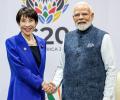
If they act now, they can reshape the strategic map of Asia without firing a shot. If they wait, the next opportunity will come only after a serious Taiwan Strait incident -- by which time the price will be far higher, and the room for boldness far smaller -- the opportunity may well be lost by then. The question is no longer whether this can or should be done, points out Varun Arya.
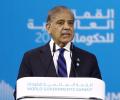
He conveyed this during a telephonic conversation with US Secretary of State Marco Rubio, according to a statement posted by the state-run Pakistan Television on X.

India and China reviewed the situation along the Line of Actual Control (LAC) in eastern Ladakh and prepared for the next Special Representatives' dialogue on the boundary question.
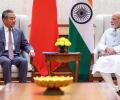
China's Foreign Minister Wang Yi expressed China's anticipation for Prime Minister Narendra Modi's visit to the Shanghai Cooperation Organisation (SCO) summit, emphasizing the importance of strong India-China relations and mutual cooperation.

Pakistan's Air Force Chief Zaheer Ahmed Baber Sidhu visited the US to enhance bilateral defence cooperation, following a similar visit by the Army Chief. The visit included meetings with US military and political leaders to discuss regional security, counter-terrorism efforts, and future cooperation.
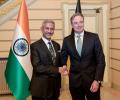
The era where nations thrived through rigid alignments is giving way to an age where the connective State defines power. For India, that era has arrived, points out Dr Nishakant Ojha.
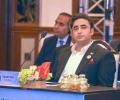
Bhutto, who served as the Foreign Minister earlier, addressed a briefing at the UN Headquarters in New York and sought reconciliation with India, making a plea for talks and Intel sharing between the two neighbours.

Modi attended the 20th ASEAN-India Summit in Jakarta. Secretary-General of ASEAN Dr Kao Kim Hourn also attended the summit.
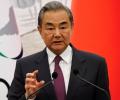
China on Tuesday called for a 'comprehensive and lasting ceasefire' between India and Pakistan, urging both countries to properly handle their differences through dialogue.
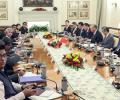
Chinese Foreign Minister Wang Yi's visit to India focuses on border talks with NSA Ajit Doval, amidst efforts to rebuild relations after the Galwan Valley clashes and rising India-US tensions.
'What's currently underway is not a 'reset'.' 'What needs to be arrived at is a new balance.'

'The background for the Saudi-Pakistan agreement is the fact that the regional security order has collapsed due to the Israeli attack on Doha.' 'The Americans have largely abandoned their security guarantee for West Asia and the region has no choice but to look at alternatives.'
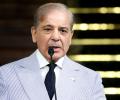
Leaders of Pakistan, Turkey and Azerbaijan agreed to strengthen their ties for the mutual benefit of their peoples, as well as for regional peace and prosperity. The understanding was reached at the Pakistan-Turkey-Azerbaijan trilateral summit in Lachin, Azerbaijan, attended by Prime Minister Shehbaz Sharif alongside presidents Recep Tayyip Erdogan and Ilham Aliyev. Azerbaijan announced a USD 2 billion investment in Pakistan's economy. Turkey expressed support for the ceasefire between Pakistan and India and hopes that it evolves into permanent peace.

Aziz stressed that Pakistan was committed to a peaceful settlement of the Kashmir problem with India as per the 'wishes and aspirations' of Kashmiris.
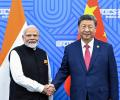
Prime Minister Narendra Modi has emphasized dialogue over discord in India's relationship with China, acknowledging natural differences between the two countries but stressing that stronger cooperation is essential for their mutual interests and global stability. In a podcast with Lex Fridman, Modi highlighted the ongoing efforts to restore normalcy along the border following the 2020 clashes, emphasizing the importance of a stable and cooperative relationship.
This is the first time such a bilateral dialogue focusing on Central Asia where the two countries have long and historical ties was held, reflecting deepening diplomatic engagement between the two neighbours even as they try to sort out friction resulting from recent reported incursions by Chinese troops along the Ladakh border
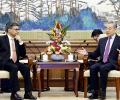
India and China held diplomatic talks in Beijing, focusing on effective border management and the resumption of cross-border cooperation and exchanges, including on trans-border rivers and the Kailash-Mansarovar Yatra. The meeting explored measures and proposals to implement decisions made during the Special Representatives (SR) dialogue in December. Both sides agreed to work together for the next SR meeting in India later this year.

"It is still not too late. India must speak clearly, act responsibly, and use every diplomatic channel available to defuse tensions and promote a return to dialogue in West Asia," Gandhi asserted.
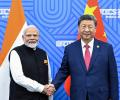
India and China celebrated the 75th anniversary of their diplomatic relations on Tuesday, with leaders from both countries exchanging congratulatory messages. The anniversary comes as the two countries are working to restore ties after a four-year freeze due to the military standoff in eastern Ladakh. Both countries have expressed a willingness to enhance strategic mutual trust and step up cooperation in various fields. The two sides are also exploring ways to rebuild ties and promote people-to-people exchanges.
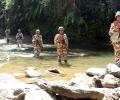
China's military has said it is willing to work with India to find a solution to the border issue, while also pushing for sound and stable defence ties. The statement comes after recent meetings between officials from both countries to normalize relations following a prolonged period of tension.
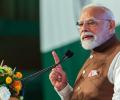
Prime Minister Narendra Modi on Friday said it is important for India and China to work together to bring stability to the world economic order as he asserted that New Delhi is ready to advance bilateral ties from a strategic and long-term perspective based on mutual respect, mutual interest and mutual sensitivity.

The Galwan clashes indicate to the limitations in relations if they do not address border stability, points out Srikanth Kondapalli.
The Galwan clashes indicate to the limitations in relations if they do not address border stability, points out Srikanth Kondapalli.
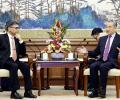
India and China have agreed to rebuild ties and resume people-to-people exchanges, including resuming direct flights and the Kailash Manasarovar Yatra this year. The two countries also discussed the resumption of dialogue mechanisms to address each other's concerns and move relations to a more stable path. The meeting comes after a period of strained relations following the Galwan Valley clashes in 2020.

In his opening remarks at the talks, Defence Minister Rajnath Singh asserted that India is confident of overcoming the challenges with a strong political will and an inherent capability of its people.
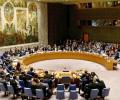
The United Nations Security Council held closed-door consultations on rising tensions between India and Pakistan, with envoys calling for restraint and dialogue. The consultations, requested by Pakistan, lasted for about an hour and a half. UN Secretary-General Antonio Guterres expressed concern over the tensions, urging both countries to avoid a military confrontation. India's former Permanent Representative to the UN, Syed Akbaruddin, said that no consequential outcome could be expected from the discussion.
'It was China's rise that caused the New Cold War in Asia as it prompted the United States to rebalance its forces in Asia to experiment with engagement and containment at the same time,' says T P Sreenivasan.
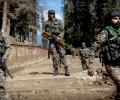
China hopes both sides will remain restrained, move toward each other, and work together to de-escalate the situation.
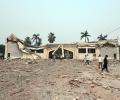
'Every decision India makes along the LoC, it must also consider implications along the LAC.'

Cooperation in key areas of defence, security and counter-terrorism will be an important aspect of Prime Minister Narendra Modi's discussions during his visit to three West Asian countries -- Palestine, the United Arab Emirates and Oman -- starting Friday.

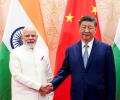
In their first structured bilateral talks in nearly five years, Prime Minister Narendra Modi and Chinese President Xi Jinping Wednesday agreed that India and China can have a 'peaceful and stable' relationship by displaying maturity and mutual respect and endorsed the pact on the resolution of the dragging eastern Ladakh border row.

The compulsion behind India and Japan to deepen security cooperation is in response to China's growing political and economic clout and its assertive behaviour in disputed areas. This has been the key driver for bringing both India and Japan closer in the domain of security cooperation, explains Dr Rajaram Panda.
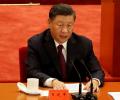
'The Asia-Pacific region cannot and should not relapse into the confrontation and division of the Cold War era,' he said at the Asia-Pacific Economic Cooperation CEO Summit via video, Xinhua reported.
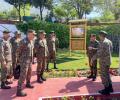
'Surgical strikes or air strikes, or both, are likely on the table.'

He also said that his country would continue to talk about the Kashmir issue "through channels that are acceptable" and prayed that "the issue is amicably resolved".
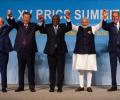
Dar also said Pakistan views Russia as an important player in the West, South and Central Asia, and strengthening mutually beneficial cooperation with Russia remains an important priority for Pakistan's foreign policy.
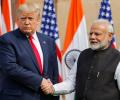
The China threat continues to resonate in the strategic partnership between India and the USA, points out Rup Narayan Das.

'The policies announced by his administration are implemented faster.'
Ahead of the crucial Indo-United States strategic dialogue, the Obama administration has said that counter-terrorism cooperation with India is a "very high priority" for it as it would help prevent Mumbai-type attacks in future.

Breaking the logjam in their ties, India and Pakistan on Wednesday announced that they have decided to engage in a "comprehensive" dialogue that will include peace and security and Jammu and Kashmir.
